
💊 I'm Sick in Japan: A Survival Guide (Pharmacy Hacks & When to See a Doctor)

💊 I’m Sick in Japan
A survival guide — pharmacy hacks, medicine cheat sheet, and when to see a doctor
A close friend messaged me at 9am: “I have a fever, the pharmacy has boxes with so many characters, and I’m scared to take anything. The staff is too busy and doesn’t speak English. Help!” I’ve been there — falling ill in a foreign country is overwhelming. But Japan’s drugstores are highly regulated and exceptionally well-stocked. Here’s your step-by-step guide to decoding Japanese over-the-counter medicine and finding medical care, featuring professional interpreter insights to keep you safe. This is a guide I put together in hopes that you will never have the chance to use it during your time in Japan, but helpful enough during the times where you truly needed it.
🧘 First Steps: What to Do When You Feel Unwell
- Stay calm and isolate — most travel bugs pass with rest, and wearing a mask outdoors or in common areas is standard courtesy in Japan.
- Rehydrate immediately — grab OS-1 (an oral rehydration solution found in drugstores) or Pocari Sweat (an electrolyte drink available at any vending machine or convenience store).
- Inform your accommodation — hotel front desks often maintain a list of nearby clinics with English support and can call ahead on your behalf.
- Call the JNTO Hotline at 050-3816-2787 for free, 24/7 English medical guidance and routing to open clinics.
🏪 Understanding Japanese Drugstores (Doh-rug-goo-sto-ah)
You will encounter two main options across Japanese cities:
- Chain Drugstores (Matsumoto Kiyoshi, Sugi Drug, Welcia, Kokumin) — large mega-stores stocking everything from cosmetics to over-the-counter (OTC) remedies. Note that while the store may stay open late, the pharmacy counter often shuts earlier.
- Dispensing Pharmacies (Chōzai Yakkyoku) — smaller, clinical shops meant specifically for processing hospital and clinic prescriptions. They are usually located directly adjacent to medical buildings.
Interpreter Tip: Download Google Lens before you step inside. Hovering your phone camera over a complex Japanese label will instantly translate active ingredients, dosages, and warnings right on your screen.
🏬 How to Spot a Drugstore on the Street
When you are dizzy or have a pounding headache, scanning Japanese signs is tough. Look out for these major chains:
- マツモトキヨシ (Matsumoto Kiyoshi): Signature bright yellow and black/blue storefronts. They are everywhere.
- ウエルシア (Welcia): Large white signs with distinct blue and green branding.
- サンドラッグ (Sundrug): Bold red signs with white lettering.
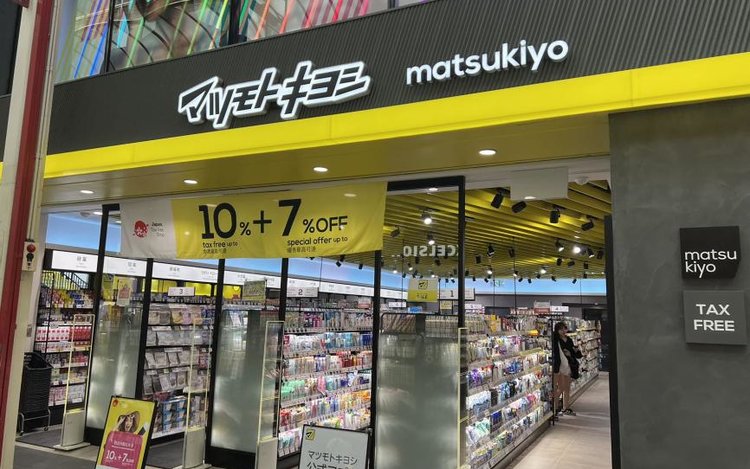 Yellow Matsumoto Kiyoshi sign
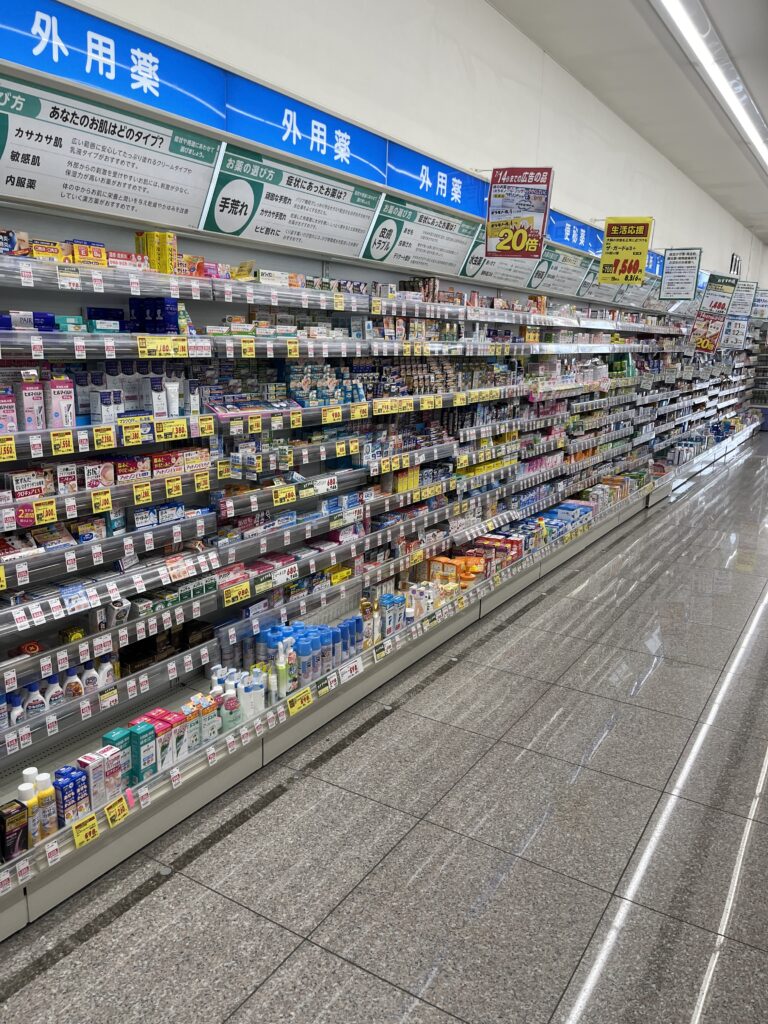 Look up for overhead banners
👀 Aisle Tip: Head past the cosmetics to the back walls. Look for overhead banners marked 医薬品 (Iyaku-hin / Medications) or 風邪薬 (Kazegusuri / Cold Medicine).
📋 Medication Cheat Sheet
These are the safest, most common OTC options available. If you are confused, show this table or the Japanese names directly to the store staff.
| Category | Brand (Japanese Name) | Crucial Notes |
|---|---|---|
| Pain / Fever 頭痛・解熱 |
Tylenol (タイレノール) EVE Quick (イブクイック) Loxonin S (ロキソニンS) |
Tylenol: Contains pure acetaminophen. Safest profile for minor fevers. EVE Quick: Contains ibuprofen and is formulated to be gentle on stomach linings (Class 2). Loxonin S: An exceptionally strong NSAID (Loxoprofen) highly favored in Japan, but classified as a Class 1 drug—meaning it cannot be purchased if the licensed pharmacist has gone off-duty for the evening. |
| Cold & Flu かぜ |
Pabron Gold A (パブロンアーローネG) Lulu Attack (ルルアタック) |
Pabron: The absolute gold-standard multi-symptom cold powder/tablet box in Japan. *Subject to anti-abuse purchase caps.* Lulu Attack: Excellent option targeting multi-symptom cold distress like severe sore throats combined with fever. |
| Cough & Throat せき・のど |
S.S. Bron (SSブロン锢) Pabron Throat Spray |
S.S. Bron is a highly effective cough suppressant capsule line. For painful local throat irritation, ask an assistant for a liquid “nodo spray” to coat the area. |
| Stomach Issues 腔痛・下痢 |
Seirogan (正露丸) Cabagin Kowa (キャベジンコーワ) |
Seirogan is a centuries-old herbal pill for diarrhea; it carries an incredibly intense, smoky campfire scent but stops stomach issues rapidly. Cabagin Kowa uses cabbage-extract compounds to target severe indigestion and painful acid reflux. |
| Allergy / Hay Fever アレルギー・花粉症 |
Allegra FX (アレグラFX) Claritin EX (クラリチンEX) |
Standard, non-drowsy second-generation antihistamines identical to western formulations, readily available over the counter. |
⚠️ The Tax-Free Trap: Drugstores will heavily promote tax-free savings if your transaction crosses ¥5,000. DO NOT do this for medicine you need immediately! Tax-free goods are legally heat-sealed in thick plastic barrier bags that cannot be opened until you exit Japan. Tell the clerk clearly: 「免税なしで、中身を上に今使います」 (Menzei nashi de, nakami wo ima tsukaimasu — No tax-free, I need to open and use the contents right now).
🔍 Decoding Medicine Labels and Symbols
If you are matching characters on raw packaging, keep an eye out for these essential terms:
- 解熱镇痛 (Netsu chintsu) — Reduces fever and halts acute nerve pain
- かぜ (Kaze) — Formulated for cold and flu symptoms
- 頭痛 (Zutsū) — Targeted headache relief
- 腔痛 (Fukutsū) — Abdominal cramping or stomach pain
- 下痢 (Geri) — Anti-diarrheal medication
- 和げる / せき (Seki) — Cough suppressants and expectorants
Drowsiness Warnings: If you spot a small crescent moon symbol 🌙 or the phrase 「眠気」 (nemuke), the drug causes drowsiness. Avoid operating rental vehicles or navigating train systems safely until it wears off.
🙏 Japanese Pharmacy Etiquette
- Talk to the pharmacist — they sit at a dedicated counter and are highly trained. 2026 Hack: If you are buying a restricted cold medicine like Pabron, clearly state: 「これは自分で使います」 (Kore wa jibun de tsukaimasu / I will use this myself). This helps satisfy the anti-abuse questioning protocols.
- Show your insurance immediately: If a clinic reception asks for coverage proof, say: 「保険の証明書があります」 (Hoken no shōmeisho ga arimasu / I have my insurance certificate).
- Don’t just grab boxes — many packages look identical but contain different active ingredients. Pharmacists will gladly guide you to the correct one.
- Stronger meds (Class 1) — These are kept strictly behind the counter or under a curtain. You must purchase them before the pharmacist's shift ends (usually around 7 PM).
🏥 When to See a Doctor
If OTC solutions fail to lower a fever or if you experience sudden, sharp pains, skip the drugstore aisle and seek an outpatient clinic immediately.
| Symptom Profile | When to Proceed | Immediate Action |
|---|---|---|
| Sustained Fever (38.5°C+) | Exceeding 48 hours without relief, or paired with mental fog | Locate an English-capable clinic; track your temperature hourly |
| Severe Vomiting / Diarrhea | Inability to hold down liquids for 24 hours | Sip small volumes of medical OS-1; visit a clinic if weakness intensifies |
| Acute Localized Pain | Instantaneous onset in chest, back, or abdomen | Do not wait for morning clinic hours. Call an ambulance at 119 (English operators are available). 119 (Ambulance/Fire) works on any phone in Japan, even without a local SIM card or roaming active. |
🗣️ Jin’s Interpreter Tip: If you spot shelves covered by small curtains or clear plastic sheets, those are Class 1 Medications (like Loxonin or strong allergy formulas). By law, these require face-to-face counsel. If a sign reads 「薬剤師不在」 (Yakuzaishi fuzai), it means the pharmacist is absent or off-shift, and store clerks are legally blocked from selling those boxes to you.
Pro tip: If you dial #7119 (the emergency medical consultation hotline), you can specifically request an English translator to help you decide if you need to go to an ER or just wait until morning.
Finding English-Speaking Medical Practitioners:
- Call the JNTO Support Line (050-3816-2787) for instant routing.
- Utilize the specialized Japan Travel by NAVITIME app, which features a vetted local clinic search tool filtered by language capacity.
🏥 Recommended English‑Speaking Clinic in Tokyo
International Health Care Clinic
〒105-0004 Tokyo, Minato City, Shinbashi, 2 Chome−10−5 Sueyoshi Bldg 3F
📞 +81-3-3501-1330
🕗 Mon–Fri: 10:00–13:00 and 15:30–18:00 (Closed Sat/Sun/National Holidays)
🌐 Official Website
Out-of-Pocket Expenses: Consultations typically begin from ¥10,000 without Japanese National Health Insurance (reimbursable via your travel policy provider).
The entire clinical staff, including physicians and nurses, speak fluent English. While walk-ins are processed, calling ahead to secure a firm appointment slot is highly recommended.
Located 4 minutes by foot from JR Shimbashi Station (Ginza / Toei Asakusa Lines).
🏥 Worse Symptoms? The 3-Step Clinic Reception Protocol
If OTC drugs aren't cutting it and you have to walk into a local neighborhood clinic, the intake paperwork can feel overwhelming. Hand over your passport, insurance info, and hold up this quick phrase sheet:
| 初めてです。 Hajimete desu. |
"This is my first time at this clinic." |
| 問診票をください。 Monshinhyō o kudasai. |
"May I have the medical questionnaire chart?" |
| 旅行保険があります。 Ryokō hoken ga arimasu. |
"I have overseas travel insurance coverage." |
💡 Pro-Tip: Google Lens handles medical check-sheets remarkably well. Take your time filling it out in the waiting lobby—clinics are highly patient and accustomed to using translation screens now! Also, remember to stay connected with Pocket Wifi or a data sim card like Klook's Japan eSIM so your applications can work!
💊 The Prescription Step: Don't Leave Empty-Handed!
In Japan, neighborhood clinics do not hand you your pills directly. Instead, the medical practitioner prints a formal paper prescription called a 処方せん (Shohōsen). You must physically carry this slip to a separate local pharmacy to get your treatment.
The Three-Step Loop:- 1. Protect the 処方せん slip: Keep this paper dry and intact. It is only valid for 4 days from the date of issue.
- 2. Track down a 調剤薬局 (Chōzai Yakkyoku): Look for signs marked with a green medical cross or the kanji characters for 調剤 (chōzai). Hand your prescription to the desk clerk along with your passport.
- 3. Clear the Counter: Standard courses of medicine (antibiotics, specialized anti-virals) average between ¥1,000 to ¥4,000 out-of-pocket. Clarify the schedule instantly by asking: 「一日何回ですか?」(Ichinichi nankai desu ka?) — "How many times a day do I take this?"
🗣 Useful Phrase for Locating a Dispensing Pharmacy:
「処方せんをもらいました。近くの調剤薬局はどこですか?」
(Chōhōsen o moraimashita. Chikaku no chōzai yakkyoku wa doko desuka?)
(“I received a prescription. Where is the nearest dispensing pharmacy?”)
- At Major Drugstores: You are perfectly fine using standard international Credit Cards, Apple Pay, or Google Pay at chains like Matsukiyo and Welcia.
- At Neighborhood Clinics (The 100% Cost Reality): Warning! Since tourists do not have Japanese health insurance, you must pay 100% of the medical bill. A basic consultation and diagnosis usually costs between ¥10,000 to ¥20,000, but adding simple lab tests or X-rays can easily push the total past ¥30,000 to ¥50,000.
- The Wallet Strategy: While large hospitals accept credit cards, many local neighborhood clinics remain strictly cash-only. To avoid getting stranded, always keep a bare minimum of ¥20,000 to ¥30,000 in physical Yen cash emergency funds on you if you plan to visit a doctor. To avoid high bank fees when pulling out emergency Yen cash at a 7-eleven ATM, I highly recommend using a Wise multi-currency card.
- 🏧 Hit with a massive ¥80,000+ emergency bill? If a clinic drops a massive cash bill on you and your wallet is empty, do not panic. Ask the receptionist to point you to the nearest 7-Eleven (Seven Bank) or FamilyMart (E-Net). Their convenience store ATMs operate 24/7, fully support English menus, and reliably accept almost all international Visa, Mastercard, and Plus debit/credit cards for instant cash withdrawal. (Just be sure to call your home bank via Wi-Fi if your card gets temporarily blocked for fraud protection!).
Because Japanese clinics prioritize human life, they will often treat you fully before asking for a single Yen. Do not abuse this trust. The Japanese government logs all unresolved medical debts into a centralized system shared directly with the Immigration Services Agency.
Under enforcement policies, the tracking threshold stands at a strict ¥10,000. If you fly home leaving an unpaid medical balance above that small amount, you will be automatically blacklisted. According to official Ministry of Health guidelines and Japanese border reports, the next time you try to return to Japan for vacation or business, you will be intercepted at airport passport control and denied entry into the country until the debt is resolved. If your bill is higher than your wallet can handle, immediately use the convenience store ATM strategy above or contact your travel insurance provider from the waiting room!
🚨 Important 2026 Medical Updates
1. Strict OTC Abuse-Deterrent Rules: Japan has severely tightened access to ingredients like dihydrocodeine (found in Pabron Gold A and S.S. Bron). You are legally limited to buying one box, and staff are required to question your symptoms or ask for ID (passport) if you appear under 20. Do not attempt to buy multiple boxes.
2. Mandatory Insurance Tracking & Visa Denials: Japan has fully integrated unpaid medical bills into their immigration database. If you leave a medical bill over ¥10,000 unpaid at a clinic, you can be denied entry into Japan on your next trip. Always carry proof of travel insurance to ensure bills are covered.
If you are dealing with an intense fever, a highly contagious bug, or a severe sinus/ear infection, flying can be dangerous (cabin pressure drops can easily rupture a severely congested eardrum). If you visit a clinic, ask the doctor for a written "Fit to Fly" certificate (or a directive stating you are unfit to travel). Major airlines frequently waive flight change penalties or change-fees entirely if you can submit a localized medical note proving you were physically unfit to board.
🧴 Prevention and What to Pack
A small, personalized travel first-aid kit can save you from navigating a pharmacy while feverish. I always pack:
- Paracetamol or Ibuprofen (from your home country, for familiar, immediate use)
- Antihistamines (if you are prone to seasonal allergies)
- Rehydration powder sachets (lighter to pack than liquids)
- Hand sanitizer and face masks (easily restocked at any Japanese convenience store)
- Comprehensive Travel Insurance — absolutely essential for peace of mind.
Remember: Japan has a world-class healthcare system, and pharmacy staff are incredibly diligent professionals. Don’t be afraid to ask for help.
💧 Tap water is safe to drink throughout Japan – no need to buy bottled water unless you prefer the taste.
☀️ Summer travellers: Watch for 熱中症 (netchūshō – heatstroke). Carry an OS‑1 or Pocari Sweat, wear a hat, and rest in air‑conditioned spaces during the midday sun.
🚌 For Motion Sickness (Nausea): Japan’s winding mountain roads, coastal ferries, and long regional bus rides frequently trigger acute motion sickness. Walk into any standard Japanese pharmacy and look for Travelmin (トラベルミン)—it is a highly reliable, incredibly cheap OTC tablet. It works best when taken roughly 30 minutes before boarding. If you cannot find the box on the open shelves, simply show the text name to the clerk.
Before stocking your travel first-aid kit, make sure you aren't accidentally carrying contraband. Japan has zero-tolerance policies for narcotics and stimulants. Over-the-counter staples from home containing Pseudoephedrine (like standard US Sudafed) or Codeine-heavy syrups are completely **illegal to import** without prior written certificate clearance (Yunyu Kakuninsho). Carrying them into airport customs can result in direct detention. Stick strictly to plain, single-active-ingredient Paracetamol or Ibuprofen packs!
🧒 If Your Child Gets Sick
Japanese drugstores carry paediatric versions of common medicines. Look for 小児用 (shōni‑yō – “for children”) on the box.
- Fever / Pain: 小児用タイレノール (Children’s Tylenol) – pure paracetamol syrup or chewable tablets, dosed by weight.
- Cold & Cough: パブロンキッズ (Pabron Kids) – multi‑symptom cold syrup.
- Rehydration: OS‑1 ゼリー (OS‑1 Jelly) is easier for small children to swallow than the liquid version.
🗣 To tell a pharmacist your child is unwell:
子どもが熱を出しました
(Kodomo ga netsu o dashimashita – “My child has a fever.”)
Finding a paediatric clinic: Look for a sign saying 小児科 (shōnika – paediatrics). Call the JNTO hotline (050‑3816‑2787) and ask for a clinic that treats children — they can filter facilities specifically by paediatric availability.
🚺 Women’s Health: Periods & UTI Relief
🩸 Menstrual products: Pads (with wings = 羽つき hane‑tsuki) and tampons are sold at every drugstore and convenience store. Show the pharmacist this phrase if you can’t find them on the shelves:
生理用品はどこですか? (Seiri yōhin wa doko desu ka? – “Where are the sanitary products?”)
🚨 Urinary Tract Infection (UTI): Antibiotics are strictly prescription-only in Japan – you must see a doctor. However, Uritore (ウリトレ) is an over-the-counter Kampo (traditional herbal) remedy that can help ease burning symptoms until you reach a clinic. Tell the pharmacist:
尿をすると痛いです。ウリトレはありますか?
(Nyō o suru to itai desu. Uritore wa arimasu ka? – “It hurts when I pee. Do you have Uritore?”)
🚨 Emergency Contraception (The Morning‑After Pill):
Great news: The morning‑after pill is now officially available over-the-counter (OTC) without a doctor's prescription at designated pharmacies across Japan. However, Japan enforces incredibly unique, strict rules for purchasing it:
👤 In-Person Only: You must show up yourself and present your physical passport. A partner, friend, or family member cannot buy it on your behalf.
💊 Witnessed Use: By law, you must swallow the tablet on the spot right in front of the dispensing pharmacist.
🏪 Where to find it: It is sold at certified drugstores under the name NorLevo (ノルレボ錠) or Lesoeru 72 (レソエル72) for roughly ¥7,000–¥7,500 JPY.
If you experience a language barrier at the counter, say or point to this phrase:
緊急避妊薬が必要です。
(Kinkyū hininyaku ga hitsuyō desu. — “I need emergency contraception.”)
If the local neighborhood drugstore does not have a certified pharmacist on shift, call the JNTO hotline immediately—they can map you straight to a 24-hour pharmacy or a discreet women's clinic nearby.
🦷 Toothache? Dental Emergencies
Sudden tooth pain is miserable. Japan’s dental clinics are everywhere – look for the sign 歯科 (shika) or 歯医者 (ha‑isha). Many accept walk‑ins, but English support varies wildly.
- 1. Find a clinic: Call the JNTO hotline and explicitly ask for an English‑speaking dentist nearby.
- 2. Expect a temporary fix: If you’re flying home soon, they will likely perform a palliative treatment (like a temporary filling) to stabilize the pain and advise you to see your regular dentist back home.
- 3. Costs: A basic tourist consultation plus an exploratory X‑ray typically runs ¥5,000–¥15,000 completely out-of-pocket without local insurance.
Pain relief until you get there: Take standard ibuprofen (EVE Quick) and avoid very hot or cold foods. Tell the dentist: 歯が痛いです (Ha ga itai desu).
👁️ Eye Troubles: Lost Glasses & Infections
👓 Lost or Broken Glasses? If your spectacles snap or vanish mid-trip, do not despair. Major Japanese urban centers are packed with rapid-service optical retail shops like JINS and Zoff. They offer affordable frame/lens bundles and feature fully automated, on-site vision testing machines. If your prescription isn't extraordinarily complex, they can usually assemble your brand-new replacement glasses in less than 45 minutes flat.
💧 Eye Infections or Irritation? General drugstores sell basic OTC 目薬 (megusuri — eye drops) designed to relieve screen strain and minor dryness. However, if you develop a painful, red bacterial eye infection (like pink eye), bypass the drugstore and search for a dedicated 眼科 (ganka — ophthalmology clinic). Most accept immediate walk-ins. Upon arrival, tell the receptionist: 目が痛いです。 (Me ga itai desu. — “My eye hurts.”)
🧠 Anxiety, Panic & Mental Health Support
🇯🇵 You’re not alone.
Falling ill or feeling trapped in a foreign country can easily trigger severe anxiety or panic attacks. Japan has English-friendly resources that understand exactly what you are going through.
📞 TELL Lifeline (Free English Crisis Support):
0800-300-8355 (Toll-Free)
Hours: 9:00 AM – 11:00 PM (Mon–Thu) | 9:00 AM – 2:00 AM (Fri–Sun)
*If you need to talk outside these hours, they offer a text chat service at telljp.com on weekend late nights.
🏥 In-Person Clinical Therapy:
If you want to book a professional psychiatry appointment or clinical English therapy session during your stay, private providers like Tokyo Mental Health (03-4550-1146) offer scheduled mental health services by appointment.
🚨 Midnight Emergency Option: If you are in immediate physical danger or having an unmanageable panic crisis at 3:00 AM when hotlines are closed, call 119 (Ambulance). Tell the operator "English, please" — they will attempt to patch in a translator and route you to an emergency hospital room with psychiatric intake capabilities.
パニック発作が起きそうです。助けてください。
(Panikku hossa ga okisō desu. Tasukete kudasai. – “I think I’m having a panic attack. Please help me.”)
📄 How to Claim Your Medical Expenses
Your travel insurance only works if you bring home the right paperwork. At the clinic reception, before you settle your bill and walk out, ask for these two crucial documents:
- Detailed receipt: 診療明細書 (shinryō meisaisho) – breaks down every treatment item and its specific cost.
- Medical certificate: 診断書 (shindansho) – an official doctor’s sign-off describing your diagnosis. Most insurers mandate this for claims exceeding ¥10,000.
🗣 How to ask for them at reception:
海外旅行保険のために、診療明細書と診断書をください
(Kaigai ryokō hoken no tame ni, shinryō meisaisho to shindansho o kudasai – “For my overseas travel insurance, please give me the detailed receipt and medical certificate.”)
Translation & Deadlines: Some insurers require a formal English translation. Google Lens can handle basic transcriptions for your own records, but if your company requires certified copies, services like Japan‑Translation.com can do it quickly online. Submit your claim as soon as you get home—policies often enforce a strict 30‑day deadline, and some companies require you to initiate the claim within 24 hours of landing back in your home country. Confirm your specific policy limits before you fly!
💡 Question: Who Translates the Paperwork? Can I translate the documents myself?
You cannot simply translate the medical lines yourself on a piece of paper—insurance adjusters will reject it. However, you don't necessarily need to pay for an expensive professional translator right away:
- For Small Claims (Under ¥15,000): Most insurance apps will accept your original Japanese receipt if you submit it alongside a clear Google Lens translation screenshot showing the matching English line items.
- For Major Claims (¥50,000+): If you are claiming high expenses for severe illnesses, X-rays, or surgeries, your insurer will strictly mandate a Certified Translation. You will need to submit the documents online to a verified translation agency (like JapanHealthcareInfo.com) to get a professionally stamped and signed English ledger.
- The Ultimate Loophole: If you call your travel insurance emergency hotline before walking into a clinic, they can often arrange "Cashless Service." If approved, the hospital bills your insurer directly through their local Japanese network, saving you from dealing with translation paperwork or paying out of pocket entirely!
*Claim Deadline Warning: Always submit your paperwork immediately. Many travel policies enforce strict clauses requiring you to initiate your medical claim within 30 days of returning home, or in some urgent cases, within 24 hours of landing back in your home country!
❓ Pharmacy and Medical — FAQ
Yes! Look for タイレノール (Tylenol). It is pure acetaminophen (paracetamol). While multi-symptom cold meds like Pabron contain it, Tylenol is much safer if you only need to reduce a fever without taking unnecessary extra drugs.
In most drugstores, the licensed pharmacist goes home by 7 PM. Once they leave, 'Class 1' medications (like the strong painkiller Loxonin S) are legally locked up and cannot be sold. Your best 24-hour alternatives are Class 2 drugs like EVE Quick or Tylenol.
This is a critical distinction! The standard Bufferin A sold in Japan is actually Aspirin (with an antacid to protect your stomach). EVE Quick, on the other hand, is primarily Ibuprofen mixed with a mild sedative to target severe headaches and menstrual pain. Always check the active ingredients using Google Lens.
Absolutely not. Antibiotics strictly require a doctor’s prescription in Japan. If you suspect a bacterial infection (like strep throat), you must visit a local clinic or hospital.
As part of the abuse-deterrent laws updated leading into 2026, pharmacies must strictly verify the age (under 20s require checks) and restrict purchases to one box per person for medicines containing specific ingredients like codeine or pseudoephedrine.
Yes! Save the JNTO Medical Emergency Hotline: 050-3816-2787. They offer free, 24/7 assistance in English, Mandarin, and Korean, and can route you to open clinics with English-speaking staff.
Yes, but look for boxes marked with 小児用 (for children). Brands like 小児用タイレノール (Children's Tylenol) sell paracetamol/acetaminophen formulations as syrups or chewable tablets. Always cross-check the dosage chart with your child’s weight using a translator app.
Many neighborhood dental clinics (歯科 - shika) accept walk-ins for emergency toothaches, though English support varies. Expect them to do a temporary fix/palliative treatment to hold you over until you fly home. A basic consultation and exploratory X-ray typically costs between ¥5,000 to ¥15,000 completely out-of-pocket.
Not always. For small clinic bills under ¥15,000, most travel insurers accept original Japanese receipts paired with a clear Google Lens translation screenshot. However, for major bills or surgeries, they will mandate a stamped Certified Translation from a recognized medical translation agency.
📌 Final Tips
- 📞 Hotline: Save the JNTO hotline (050-3816-2787) in your contacts before your flight.
- 🛡️ Insurance: Keep a digital copy downloaded on your phone for immediate clinic registration.
- 🆔 ID: Always carry your physical passport to the pharmacy for restricted medications.
- ⚠️ Allergies: Have a list of your specific allergies ready. Show this phrase to the pharmacist: 「[Allergy Name] アレルギーがあります」 ([Name] arerugī ga arimasu).
- 💊 Prescriptions: Bring a printed copy of your home prescriptions in English to help Japanese doctors match the chemical equivalents.
- 🌡️ Hydration: Buy OS-1 at the first sign of fluid loss.
⚠️ Bonus — Jin’s Personal Tip: Dealing with Drug Allergies
If you have drug allergies, do not rely on your memory or pronunciation when you are feeling dizzy and unwell. I am personally allergic to Cefaclor (an antibiotic), which causes me to vomit and develop severe rashes on my limbs.
While many clinics now use tablet-based intake forms, having a pre-written "Medical ID" note on your phone screen bypasses all language barriers instantly. Here is what mine looks like:
Sefakuroru [Kōsei-busshitsu] ni arerugī ga arimasu.
(I have an allergy to Cefaclor [antibiotic].)
服用すると、傐吐(おうと)と手足に発疹(はっしん)が出ます。
Fukuyō suru to, ōto to teashi ni hosshin* ga demasu.
(If I take it, I will vomit and get rashes on my limbs.)
*Also traditionally read as ‘hasshin’, but ‘hosshin’ is highly common in medical contexts.
Key Vocabulary to Build Your Own Note:
・ Antibiotic: 抗生物質 (Kōsei-busshitsu)
・ Vomiting: 傐吐 (Ōto)
・ Rash: 発疹 (Hasshin / Hosshin)
・ Limbs (Arms/Legs): 手足 (Te-ashi)
Have you ever needed medical help in Japan? Share your experience in the comments below — your stories help other travellers feel much more confident!

*Disclosure: This post contains affiliate links. If you book through them, I may earn a small commission at no extra cost to you. This helps keep the blog running — thank you! 🙏

0 comments